
Start a Cassia Property Search
The fastest entry point is the public Cassia County Parcel Search, once you hold an address or parcel number. It returns situs, legal-description, value, and tax clues. The public form exposes no owner-name field. The owner panel on a parcel card requires login. That limit makes the legal description your workhorse. Take it to the Recorder for deeds and liens, to planning staff for plats and permits, and to the Treasurer for tax questions. A map helps. An assessment record helps too. Neither one guarantees title or fixes a legal boundary.
- Search the assessor portal by address or local parcel number.
- Copy the parcel status, situs, and legal description from the result.
- Ask the Recorder for current and prior deeds, liens, releases, and referenced plats.
- Use tax, planning, court, and state GIS sources for their separate facts.
- Inspect or order the official file when the needed item is not online.
Cassia County Records Desks
Three offices anchor the property trail in Cassia County. The Recorder keeps legal instruments and plats. The Assessor maintains parcel and valuation data, and the Treasurer handles bills, payments, payoff balances, and tax-deed notices. Visit each desk with the parcel number in hand.
Cassia County Recorder
1459 Overland Ave, Room 105
Burley, ID 83318
208-878-5240
Cassia County Treasurer
1459 Overland Ave, Room 102
Burley, ID 83318
208-878-7202
Inside Cassia Parcel Results
The county portal accepts a Parcel Number or an Address. Address autocomplete kicks in after two characters. A blank form prompts for at least one field. Results list the parcel number, address, and legal description, marked as active, terminated, or future status.
| Public field | What it adds | Limit |
|---|---|---|
| Parcel and status | Exact county assessment key | Status can change after splits or merges |
| Situs address | Physical locator | Not the owner’s mailing address |
| Legal description | Townsite, lot, block, or other land key | Not a boundary survey |
| Category and tax cards | Value components and tax history | Owner field may be gated |
The Oakley parcel card shows category values, taxation cards, and legal information. It lists no public owner, last-sale date, or sale price, so request any missing field from the office rather than guessing.
Cassia Deeds Are Not Fully Online
The Clerk-Auditor-Recorder indexes and microfilms deeds, mortgages, liens, judgments, plats, surveys, and corner records. The county publishes no online grantor-grantee portal. It states no cutoff year, so the claim that everything is online fails here. Call or email ahead. Vault and computer research time is limited. Give staff the parcel, legal description, grantor and grantee names, instrument type, and date range. Ask for the index entry first. Then request the recorded image and every key referenced instrument.
The Burley County-Line Test
Burley straddles the Cassia and Minidoka county line. A Burley mailing label proves nothing about which county holds the parcel. Confirm it through the assessor result, tax code, parcel key, legal description, and recorded instrument. This trap touches deeds, taxes, permits, and plats alike. A failed Cassia County property search may simply mean one thing. The address sits on the Minidoka side. An annexation, replat, or older street description can also explain the miss. Burley planning files clarify those changes. The correct county Recorder still controls the instrument trail.
Cassia Property Record Types
Every record set documents one slice of a Cassia County parcel. Search by the question you need answered, then cross-check identifiers rather than treating office records as interchangeable.
| Record Type | What It Documents | Kept By | Access |
|---|---|---|---|
| Deeds and conveyances | Recorded transfers and parties | Recorder | Limited office research and copies |
| Mortgages and liens | Recorded burdens and releases | Recorder and courts | Index request and case search |
| Assessment and tax | Parcel values, charges, payments | Assessor and Treasurer | Public portal and office |
| Plats and surveys | Lots, blocks, easements, dedications | Recorder and planning | Copies and physical files |
| Permits and zoning | Approved work and land-use action | County or city | Forms, hearings, office request |
Turn to Cassia County deed records for the filed transfer and its referenced documents. Assessor and Treasurer data answer value and bill questions, while planning files explain development but convey no title.
Cassia Taxes and Payoffs
The Treasurer manages bills, due dates, payoff balances, payments, and tax-deed notices. Online payment needs the bill number. That number changes each year. The published card fee is 2.5 percent; the e-check fee is $1. Call for a payoff, since interest can accrue daily. The assessor parcel card lays out market-value components, exemption fields, gross tax, special charges, reductions, payments, penalties, and total due. That history is not a sale-price record. Deeds and transfer papers remain the real evidence of what a property sold for.
Cassia Plats and State GIS
Cassia County offers no dedicated parcel-viewer interface. The IDWR parcel layer supplies statewide polygon and PIN context. But it warns against ownership or boundary conclusions. Owner values can be null. Recorded plats carry more weight for lot and block research. Cassia's subdivision rules tie final-plat approval, address assignment, and recordation together. Pull any amended or vacated plat when the legal description names a townsite or subdivision.
- Parcel
- A tax and assessment unit identified by a local key.
- Plat
- A recorded drawing of lots, streets, easements, and dedications.
- Grantor
- The party conveying an interest.
- Grantee
- The party receiving an interest.
- Assessed value
- A tax-system value, not a sale appraisal.
Older Cassia Land Clues
Cassia County was formed in 1879. Its seat moved from Albion to Burley in 1918. The present courthouse dates to 1939. Those shifts can scramble place and office references in an older land trail. No courthouse fire or record loss marks the county's history, though. The Idaho State Archives lists Cassia land, tax, court, probate, mining, water-right, and vital categories. Newspaper microfilm includes the Burley Bulletin, Burley Herald, Cassia County Courier, and selected Albion titles. These sources can yield a name. They can also yield a sale notice, a subdivision clue, or a probate lead. The filed deed or court order still confirms the legal event.
Cassia Permit Paper Trails
Cassia County Zoning and Building keeps building, subdivision, land-division, floodplain, conditional-use, variance, and right-of-way files. The county publishes no online completed-permit index, so physical files and records requests matter. City jurisdiction matters too. Burley posts planning and permit forms. Oakley routes requests through community development. Declo edge parcels may fall under county area-of-impact rules. Ask which government held authority on the action date. Then request the application, map, staff report, approval, and final recorded plat.
Request Cassia Records in Writing
The Idaho Public Records Act, found at Idaho Code sections 74-101 through 74-126, gives every requester a written path. Cassia County publishes no online tool for a nonexempt record. The county's form is simple. It asks for a clear description of the record. It also asks for a date and whether you want inspection or copies.
A strong property request gets specific. Name the address. Name the parcel number, the legal description, the record type, and a date range. You can ask for instruments, plats, applications, staff reports, notices, and orders. Ask also for document numbers and any referenced records. If the custodian claims an exemption, request that the nonexempt parts still be released.
Cassia Fraud and Sale Notices
The Cassia County Recorder's fraud notice points a suspected victim toward local law enforcement, an attorney, or a title insurer. The county offers no fraud-alert enrollment page. So treat any urgent paid signup that imitates county branding as unofficial.
For delinquent parcels, the Treasurer's tax-deed sale page is the current source for sale notices. It also carries excess-proceeds information. Remember that a notice only starts a process. It does not prove a final deed issued. Check the recorded result and later filings.
Cassia Courts and Title Disputes
Some property questions outgrow the land-record system. They end up in court. Foreclosure suits, quiet-title claims, partitions, probate sales, lien enforcement, and judgments can all land in Cassia District Court. The public Idaho iCourt portal supports party and case-number searches and can display case information, parties, events, hearings, dispositions, and financial entries.
A docket entry is not the filed document. Get pleadings, orders, and certified copies from the Cassia court clerk or courthouse access channel where they are public. Then match any lis pendens, judgment lien, deed, or release back to the Recorder. A case result alone does not prove that a judgment attached to a particular parcel.
Cassia Assessment Field Visits
Cassia County's Assessor inspects each parcel once in a five-year cycle under Idaho Code 63-314. Weekday visits may update photos, condition, depreciation, improvements, permits, new construction, and changes of use. The work keeps the assessment roll current.
The county also publishes limits on government entry. It notes that observation happens from lawful public vantage points. An assessment inspection does not inspect title. It may explain a changed improvement value or category. But the Recorder remains the source for a transfer. A survey remains the source for a disputed line.
Read Official Cassia Screens
Check the official interfaces before making an office request. They show what is public and what is missing. The Cassia Parcel Search source displays the county's parcel and address entry points for property records.
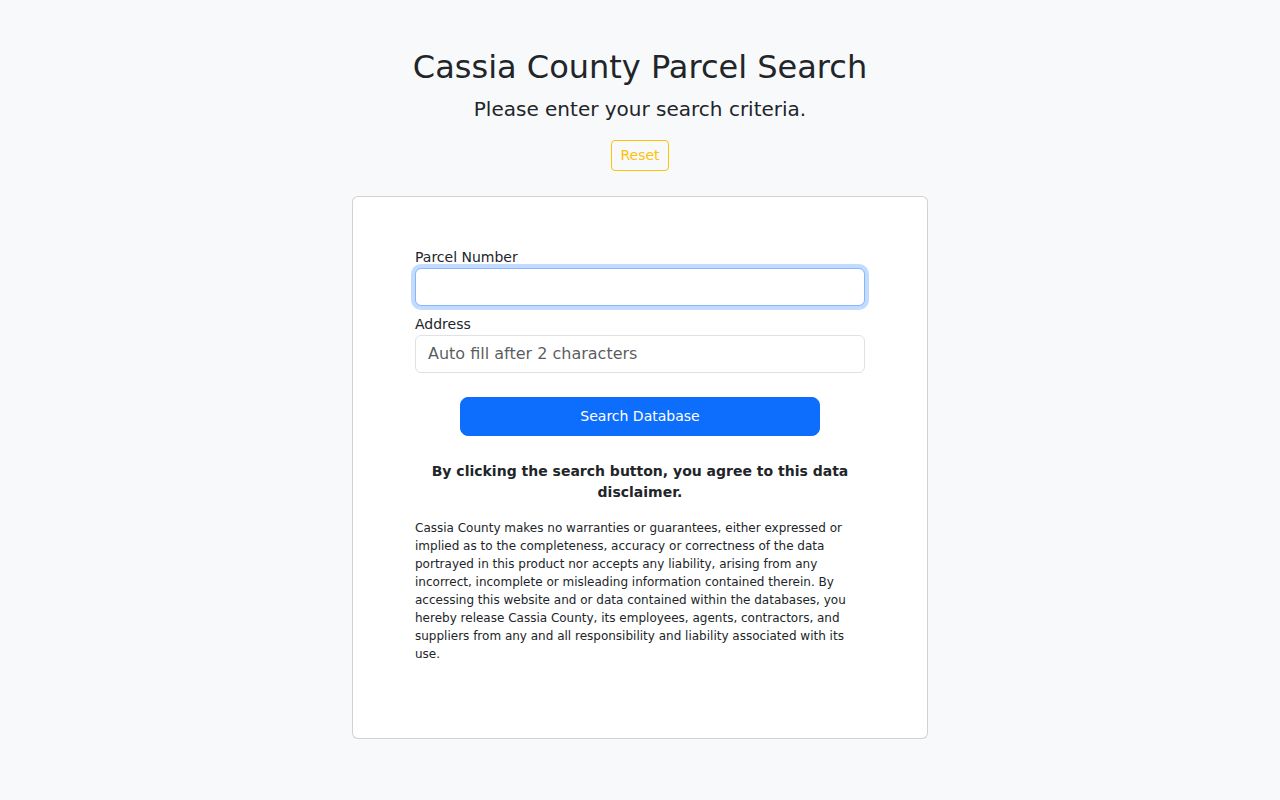
That page confirms the address and parcel entry points. It also helps a researcher describe a failed search precisely when contacting the Assessor. The Cassia Recorder source documents the office route for recorded land instruments.
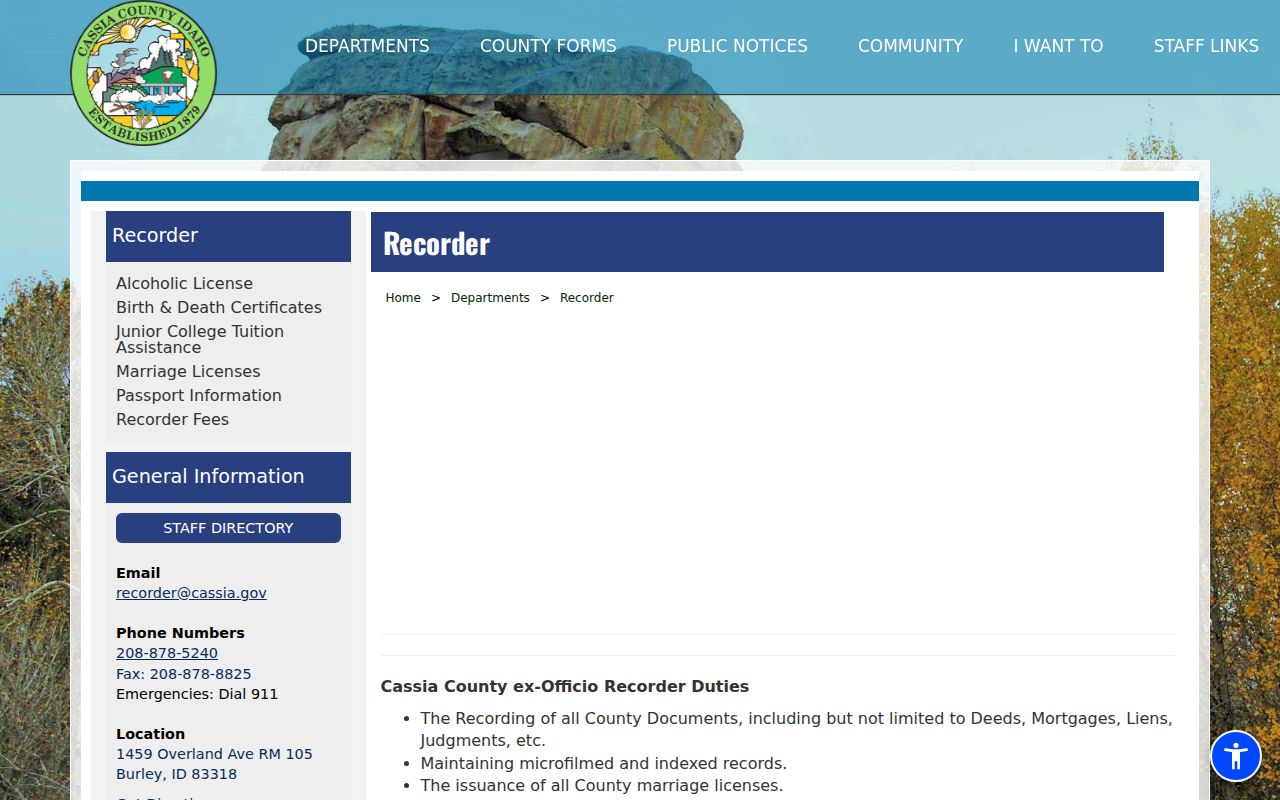
The Recorder's page is the verified starting point for indexed and microfilmed deeds. Cassia County publishes no public grantor-grantee interface, so that office route carries the deed records.
Payment channels matter to the Treasurer. Checks should name the parcel and the current bill number. The courthouse drop box takes no cash. Mailed payments ride on the postal postmark, so mail early. A tax-deed notice starts a process; it does not finish one. Do not claim who holds title yet. Confirm the final deed or order first. Then inspect the Recorder filings that came after it.
The state parcel service exposes PIN, county, object ID, area, and length fields. Sample Cassia parcels carried identifiers unlike the local assessor key. Their owner values were null. Keep both identifiers on hand. Then use the legal description to test whether the two records describe the same land. Treat state geometry as a reference layer, never as a legal survey.
The Idaho State Archives has digitized only part of its collection. Appointments are requested at least 48 hours ahead. A promising entry deserves careful notes. Save the index wording. Save the county, the category, and the catalog reference. Pair each archive lead with Recorder microfilm and the deed books. A broad request for every land record tied to a surname rarely pays off.
The county land-use inventory is broad. It covers accessory dwellings, manufactured homes, and agricultural siting. It also tracks floodplain review, conditional uses, variances, planned developments, rights-of-way, and complaints. A permit can explain a later assessment change. It cannot prove the applicant owned the land. Match the permit to the deed and the parcel that was current on the filing date.
Idaho's request process runs on staged response times. Fees can apply beyond the resident allowances. Those allowances cover the first two labor hours and the first 100 pages. Cassia's form includes fields for extensions, exemptions, attorney review, costs, and appeal. If any part is withheld, ask the custodian to cite the legal basis. Request release of every nonexempt portion at the same time.
Recorder requests also deserve a fresh fee schedule. Paper copies, certified documents, electronic images, referenced instruments, and staff research are separate charges. Get an index reference first. Then identify the exact pages you need. Verify the live fee page close to your order date. That discipline trims cost without skipping a deed, release, plat, or other cited instrument.
Cassia's public parcel detail separates legal, property, category, and taxation information. One Oakley record showed a tax-code area and townsite lot-and-block wording. It listed land and improvement categories. It carried separate annual tax cards. Its deed-reference field was blank. Its owner panel was gated. Record a blank field as unavailable. Filling it from a generic parcel profile invites error.
Estate transfers reward cross-checking. Compare the decedent's name and probate case with the recorded successor instrument. Several instruments may explain the change of owner of record. An executor deed, affidavit, survivorship event, or trust paper can each do it. If no court case appears, search the Recorder anyway before concluding no transfer occurred. Newspaper and death-record clues help with identity or timing. The court order and the filed instrument still establish the property event itself.
Limits of Cassia Property Records
Cassia County property records can identify parcels, recorded parties, and filed burdens. They cover assessed values, tax history, plats, and public land-use actions. They cannot guarantee clear title. They cannot fix a surveyed boundary, prove who occupies a site, or supply an appraisal of likely sale price. Public access has limits as well. The assessor owner panel is gated. Some court files are restricted. Protected personal identifiers should not be sought or redistributed. Idaho Code section 74-120 also bars using public records to build mailing or telephone lists.
Lawful use. Cassia County property records support purchase research, estate work, boundary questions, and civic review. Never use personal data to stalk, harass, threaten, or harm anyone.
For a purchase or contested interest, get qualified title advice. For a boundary, use a licensed survey and the recorded plats. That keeps public records useful without asking one database to prove more than it can.