
Cassia County Owner Record Card
The Cassia County assessor's parcel page includes an Owner Information panel. On the public Oakley sample, that panel shows no name. It requires a login instead. Neighboring fields stay visible on the card. No mailing address, last sale date, or deed reference appears for the public to see on the Cassia County property records page.
| Owner Name | Located in Owner Information; hidden on the inspected public card |
|---|---|
| Mailing Address | Request with the owner field; not visible in the public sample |
| Situs | Property address displayed on the parcel detail |
| Parcel Status | Active, terminated, or future status shown with the parcel key |
| Legal Description | Land identity used to match the parcel to a deed or plat |
| Deed Reference | A field exists, but it was blank in the inspected sample |
This is a current-owner record card, not a portal inventory. The real question is what the tax roll says now. Newer recorded evidence may change the answer. The visible tax code, category values, and taxation years can help match two Cassia County records to the same land. None of that substitutes for the hidden owner field. A blank deed-reference row proves nothing either. It does not mean no deed exists. The Recorder search should instead run on the parcel number and legal description. That is the reliable path through Cassia County deed records.
Cassia Current Owner Login Gate
The Cassia County Parcel Search runs on one public form. It accepts only an address or parcel number. The owner panel displays a single message: "You must be logged in to view this." The login screen offers username and password fields. The county publishes no public registration process. No subscriber price or account rule appears anywhere either. A blank public view is not a blank owner record. The owner of record still exists on the tax roll. Contact the Cassia County Assessor at 208-878-3540 or assessor@cassia.gov. Ask what owner access is permitted for the parcel. Give the parcel number and legal description to keep the request focused. The sample Cassia parcel detail page shows the Owner Information area. It sits beside the public legal and property fields. Parcel identity is visible there. The current owner name is not. Anyone searching Cassia County property records by parcel hits this one wall. That field requires an office or account channel.
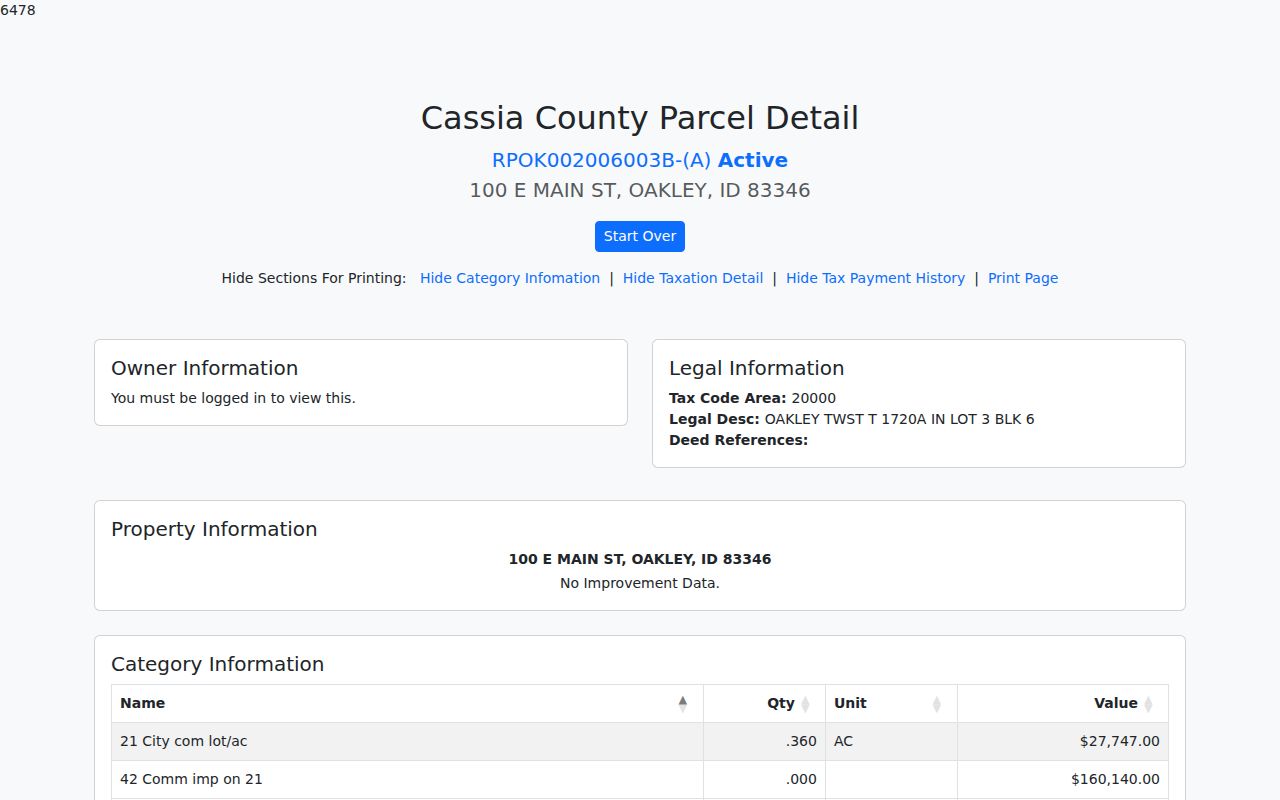
The gap is plain. Public parcel identity is open, but the current owner name needs an allowed office or account channel within Cassia County property records.
How Current Is Cassia's Owner
Deeds and assessment rolls follow different clocks in Cassia County. A deed enters the land record once the Recorder accepts it. The assessor builds parcel and owner data separately. That split explains most timing gaps. Cassia County publishes no fixed deed-to-roll lag, so no one can promise a set number of days.
After a sale, the assessor's permitted view may still list the prior owner of record. Pull the newest recorded conveyance instead. Match its legal description to the same parcel number. If the names disagree, ask each office when its records last changed. A corrective or later instrument may exist.
Recent-sale check. A Cassia County assessment roll can lag a recorded transfer; use the newest matching deed to verify the current owner.
Verify Cassia County's Current Owner
A solid verification ties four things together. Keep the address, parcel number, legal description, and newest deed in one stack. The Cassia County Recorder indexes and microfilms deeds and other conveyances, though the office publishes no online grantor-grantee index.
- Search the situs address and choose the result with the matching legal description.
- Copy the parcel number and status exactly from the county result row.
- Obtain the owner of record through the permitted assessor or office channel.
- Ask the Recorder for the newest deed using parcel, legal description, names, and a date range.
- Compare the deed's grantee and land description with the assessor owner field.
- Owner of record
- The party named in the official owner field when that record was checked.
- Assessment roll
- The assessor's working record of parcels, value, classification, and owner data.
- Situs address
- The place where the parcel is located, which may differ from owner mail.
- Recording lag
- The unmeasured time between a deed event and a later roll update.
The wider address-to-owner method lives on the Cassia County property owner lookup. Here the goal is simpler: compare evidence, not trace a full title history.
Cassia Parcel Status and Owners
Cassia's result legend labels each parcel active, terminated, or future. The Oakley key in question carries an active suffix. Status is not trivia. A terminated parcel may have been split or merged. A future key may not yet work like an active tax parcel on the tax roll.
Never pin an owner of record to a retired or neighboring key. First confirm the legal description and the current parcel status. Then ask whether a successor parcel exists. One deed can also span several assessor keys, so the Recorder match still matters.
Cassia Owner Mail Versus Situs
The public sample in Cassia County shows the situs address plainly, yet owner mail stays hidden. Ask for each field by name. The situs address fixes where the land sits. The mailing address serves a different job: it routes notices and tax bills, and it can be a post office box, an agent, an estate, or an out-of-county location.
A mismatch between the two proves nothing on its own. It does not mean the owner of record lives elsewhere, and it does not signal an error in the property records. The two fields simply serve two different functions. Use owner mail for lawful contact about the parcel only, and never redistribute protected identifiers that appear in a recorded image.
Cassia Current Entity Owners
When the owner of record in Cassia County is an LLC or corporation, copy its exact legal name into Idaho SOSBiz. Entity status, filings, and the registered agent can explain who receives formal contact. One caution applies. The business record does not prove the entity holds this parcel. The latest deed remains the true ownership link.
Trusts and estates deserve the same care. A trust name may call for the recorded deed plus allowed related records. An estate can turn on a probate order or an executor deed. Match names, dates, case references, and the legal description. Do not substitute a person merely associated with the entity.
Burley Current Owner County Check
Burley sits in two counties. The city straddles the Cassia and Minidoka county line. A mailing address proves little about which roll holds the parcel. A ZIP code cannot settle the question. Before trusting any current owner result, confirm the county through the parcel number, tax code, legal description, and recording office. That geographic split also explains a puzzle. An expected name or parcel may be absent from Cassia County property records. Broadening a person search is riskier than checking the county. The deed record follows the land. Keep the recording county attached to every instrument reference you collect. Burley planning data may describe the whole city. The assessor and recorder split custody at the county line.
Cassia Assessment Visits in 2026
A May 2026 notice from the Assessor described weekday field visits across Cassia County. Staff update photos, condition, permits, improvements, and changes of use. Idaho's cycle inspects each parcel once every five years. The work feeds the assessment roll and property records. But it is not a title check. Contact happens at the gate or by mail. When entry is denied, the office falls back on the best available information gathered from a lawful public vantage. Mailed follow-up follows. An assessor visit never verifies the owner of record.
Use Cassia Owner Records Lawfully
Idaho law does not permit stalking or threats. Public-record access also stops at list-making: Idaho Code §74-120 bars using records to build mailing or telephone lists. Tie each request to a parcel or deed. Use the least personal data the task needs. A current owner record is not a title opinion. It cannot show who actually occupies the land or stand in as proof of title. For a purchase, estate, boundary, or fraud question, pull the underlying deed records and seek qualified help when legal title is at stake.