
Cassia Deed Records by Type
Deeds, mortgages, liens, judgments, plats, and surveys all pass through the Cassia County Recorder. The recorder keeps grants, conveyances, and other recorded instruments for the county. The label on a deed tells you what kind of event happened. That helps. Still, the deed's own terms matter far more than the type name alone. So do the documents it references.
| Deed Type | What It Does | Common Use |
|---|---|---|
| Warranty deed | Conveys title with stated promises | Ordinary arms-length transfer |
| Quitclaim deed | Conveys whatever interest the signer has | Family, estate, or title cleanup |
| Trustee or executor deed | Transfers through a fiduciary | Trust or probate administration |
| Tax deed | Records a transfer after the statutory tax process | Tax-delinquent property |
| Reconveyance | Shows release of a deed of trust | Loan payoff trail |
A deed transfers an interest in property. Mortgages, deeds of trust, judgments, and liens work differently; they burden an interest rather than pass it along. Before treating an older encumbrance as still open, read any later release or reconveyance filed in the Cassia County deed records.
The Cassia Recorder Route
For title documents, the office to contact is the Cassia County Ex-Officio Recorder. It is the county's home for recorded deeds and other property records. Its Recorder page describes records that are indexed and microfilmed. The county publishes no public web search screen for its deed records, so do not assume deed images are available through a county portal or credit any online coverage year that the office has not stated.
Clerk-Auditor-Recorder
1459 Overland Ave, Room 105
Burley, ID 83318
208-878-5240
recorder@cassia.gov
Vault and computer research is open to the public on a limited basis. The office asks researchers to call or email ahead, and its notice warns that survey and construction business work may take priority over other requests.
Build a Cassia Deed Request
A well-built request gives the recorder's staff several paths to the same parcel. List every current and former name you know, plus the parcel number and the full legal description. Add the subdivision or townsite, the lot and block, rough recording years, and the instrument type you want pulled from the deed records.
| Search clue | Why it helps | Where to get it |
|---|---|---|
| Grantor or grantee | Points into the party index | Known deed, estate file, assessor inquiry |
| Legal description | Stays tied to land when names change | Parcel result, deed, or plat |
| Parcel number | Connects current assessor data | Cassia Parcel Search |
| Date range | Narrows index and microfilm work | Sale, probate, or tax clue |
| Referenced instrument | Reveals prior deed, lien, plat, or release | Main document |
Ask for the index entry first, since it leads to the document number or book and page. Once that reference is in hand, request a plain copy and a certified copy of the deed, along with every material instrument it references.
Cassia’s Grantor-Grantee Chain
Deed records are usually traced through the grantor, the person or entity giving an interest, and the grantee receiving it. Cassia County confirms that its records are indexed this way. The county publishes no index fields or earliest book online, though, so the details come from the office itself.
- Find the latest deed by using the current grantee, parcel, and legal description.
- Read the grantor, recording reference, land description, and cited prior instruments.
- Search that grantor as an earlier grantee, then repeat for each transfer.
- When the office index changes format, ask for the older deed book, reverse index, or microfilm reel.
- Grantor
- The party giving or conveying the stated interest.
- Grantee
- The party receiving the stated interest.
- Chain of title
- The linked sequence of transfers affecting the same land.
- Book and page
- A volume reference used to retrieve a recorded document.
- Instrument number
- A unique filing reference assigned at recording.
Exact names matter most in a grantor-grantee search. Try entity suffixes and every name variant that appears on the instrument, and keep the legal description beside each hit.
Cassia’s Published Deed Fees
The Recorder's fee schedule effective July 1, 2026 splits recording charges from copying costs. Research costs are separate too. Deeds, grants, transfers, and conveyances run $15 for the first 30 pages. After that, each page costs $3. Mortgages and deeds of trust carry a $45 base for 30 pages. The same $3 per page applies beyond that.
Copies add up differently. Paper copies are $1 per page. Certification is $1 per document. Surveys run $5 per page. Requests over 100 pages cost $1 per page. Research past two hours is billed at $10 per hour. Each referenced instrument after the first adds $1. Check the current schedule before placing a large order, since the fee page can change.
Note: Ask for an index reference before ordering pages, especially when a chain may include many instruments.
Older Cassia Deeds and Microfilm
Cassia County dates to 1879. The Recorder publishes no first deed-book year, no exact volume runs, and no digitization cutoff for older Cassia County deed records. Request the earliest grantor and grantee indexes instead. Ask also for the deed-book series, plat books, survey books, and any reindexed volumes. Those often hold the earliest transfers. The Idaho State Archives indexes list Cassia land, tax, court, probate, mining, and water-right material. A hit there is only a pointer. The original, a certified copy, or the county instrument still has to be inspected. Do that at the repository responsible for it.
Local history adds one more wrinkle. Cassia's county seat moved from Albion to Burley in 1918. The present courthouse dates to 1939. So place and office references may shift across the deed records. No courthouse fire or destruction story appears in official county history. Do not attribute gaps in Cassia property records to one.
Plats Link Cassia Deeds
A recorded plat often bridges an old deed and a modern Cassia County parcel. Some Oakley deeds describe land by townsite, tract, lot, and block instead of street address. Pull the plat itself whenever a deed references a subdivision. Amended and vacated versions matter too.
Final plats map lot lines, street names, rights-of-way, easements, dedications, and restrictions. They clarify which land a deed conveyed. Still, no plat or state GIS polygon replaces a boundary survey.
Cassia County Title 10 ties planning review, address assignment, and final-plat recordation together. That sequence explains a common puzzle. It shows why a current situs address never appears in an older deed. When the chain crosses a lot split or replat, set the parent description beside each later lot. Then request the instrument that created the new legal unit. Keep an old parcel number out of your chain unless the assessor and the recorded plat both support it.
Probate Transfers in Cassia Records
A death often sends property through probate. The paper trail may include a probate order, executor deed, affidavit, survivorship transfer, or trust instrument. All of it is recorded. Search Idaho iCourt for case details first. Then request filings from the Cassia court clerk where they are public. Bring the decedent's name variants, case number, representative, and inventory description, and sale approval into your Recorder request.
No probate docket does not mean no transfer. Survivorship or a nonprobate trust can move title without a court trail. A deed record still gets left behind.
Liens Beside Cassia Deeds
Read the whole instrument trail, not just the deed. Cassia County records mortgages, deeds of trust, judgments, liens, reconveyances, and releases alongside conveyances. Each tells a different story. A loan filing proves debt, not ownership. A judgment only binds a parcel when the recording trail actually ties it there.
Treat a tax-deed notice the same way. Confirm the Treasurer's sale process. Then pull the final deed or order and hunt for later recordings against the parcel number. Easements and restrictions often hide in a plat note. They can also lurk in a referenced document that never made it into the main deed.
Cassia’s Fraud Notice
The Recorder points anyone who suspects a fraudulent recording toward local law enforcement. It also names an attorney or a title-insurance company as options. Cassia County publishes no official enrollment page for deed-fraud alerts. Skip any service implying the county requires paid monitoring.
Preserve a suspicious deed carefully. Record its instrument number, filing date, parties, legal description, and source. Compare it against the prior deed and study the notarized acknowledgment. But never confront a named individual or misuse public contact data.
The acknowledgment can be checked within the document trail. A notary record still does not prove the signer owned the parcel. Nor does it prove that the conveyance was valid. Keep the recorded image, index entry, prior deed, and any correction instrument together. Let the proper public office or a qualified professional weigh the legal effect.
View Cassia Recorder Sources
The official Recorder page is the access point for Cassia County deed records and limited public research.
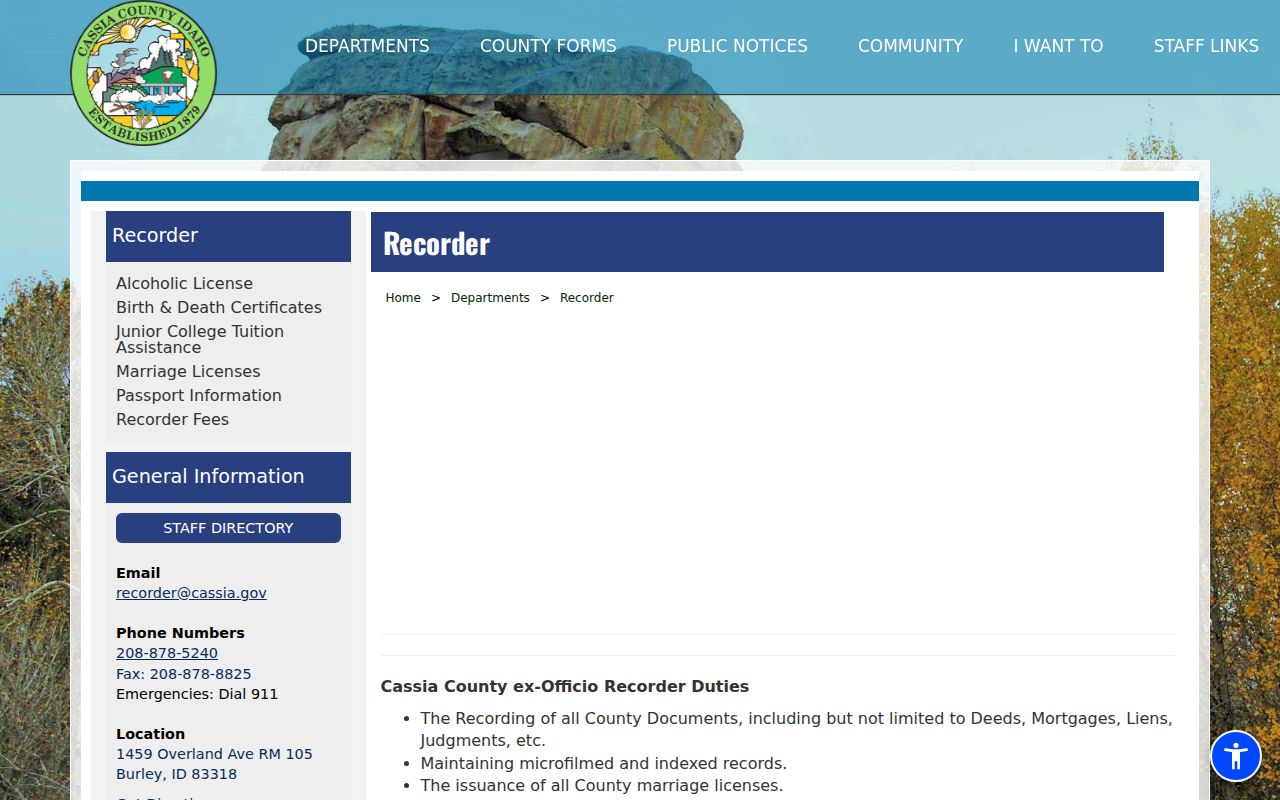
That page describes the office's indexed and microfilmed holdings without advertising a public online grantor-grantee tool. The current Recorder fee source breaks out deed, mortgage, copy, survey, and research charges.
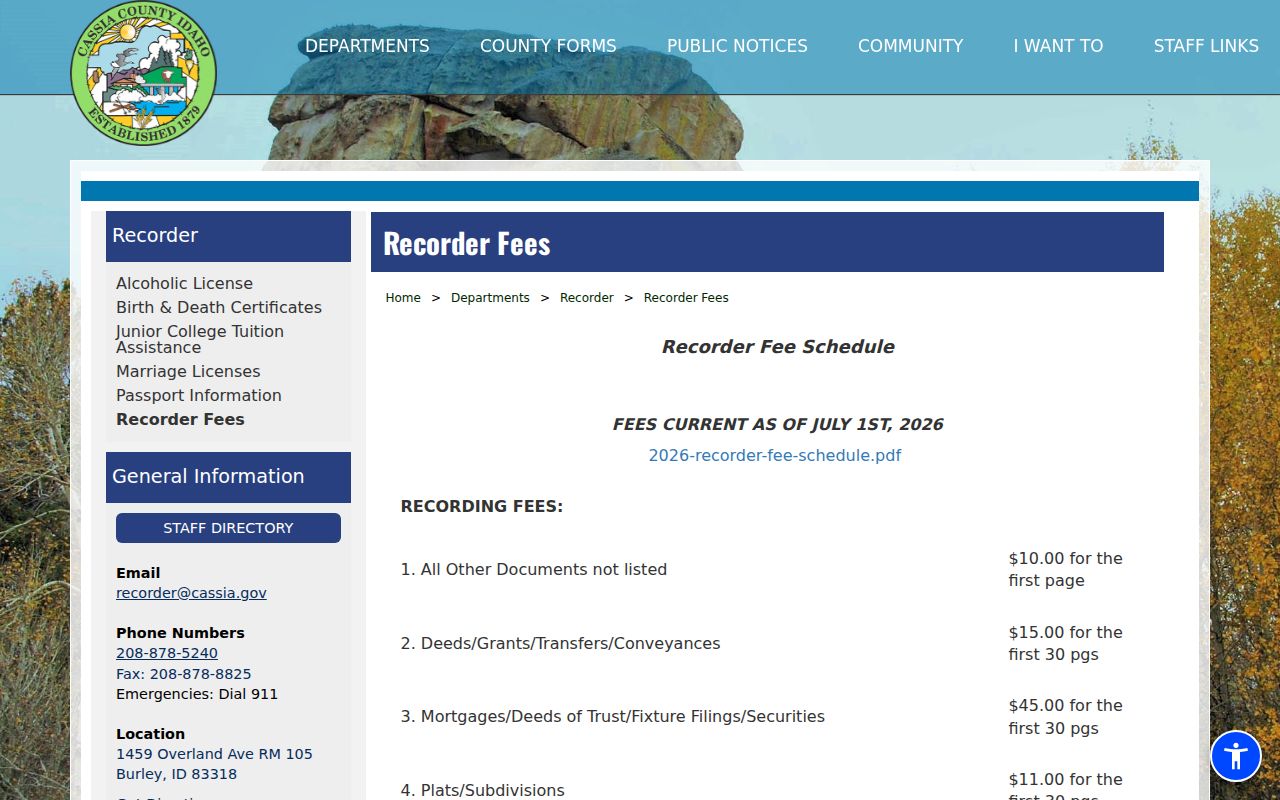
Check that fee schedule near your order date, and bring a document reference so you pay only for the pages you need.
Order a Cassia Deed Copy
Cassia County offers no public online deed-image portal. Order instead through the Recorder counter, phone, email, mail, or a focused county public-records request. Supply the index reference if you have one. Say whether a plain or certified copy is needed. For mailed recordings, the published rules require an original or certified copy, notarization, the required recording space, payment, and a stamped return envelope.
Office access can be limited. Schedule your research visit ahead, and ask staff which index, book, or microfilm holds the entry. Keep the receipt and the full retrieval reference with your copy.
Recorded, not guaranteed. Cassia County deed records show what reached the public record. They do not identify every possible unrecorded interest or provide a title opinion.
Purchase, estate, easement, and fraud questions may call for qualified title or legal review. Remember what a certified copy actually proves. It shows the office certified that copy, not that the transaction is beyond dispute.