
Build a Cassia County Former-Owner Timeline
Start with the newest instrument and work toward the past. Each row below is a worksheet. Cassia County publishes no online grantor-grantee screen, so no cutoff year exists either. Treat the table as a research worksheet, not a sample ownership claim. Every row should trace to an index entry or instrument and carry enough detail to reconnect the same parcel at the next step back.
| Transfer Date | Grantor to Grantee | Deed Type | Book/Page or Instrument |
|---|---|---|---|
| Most recent recorded date | Seller named as grantor to buyer named as grantee | Warranty, quitclaim, estate, or other deed | Copy the exact index citation |
| Prior recorded date | That grantor's seller to that grantor | Read the instrument label | Copy the prior deed reference |
| Earlier recorded date | Repeat the prior-owner link | Note probate or trustee language | Move into book, page, or microfilm |
Give every transfer its own line, even when two deeds share a single recording date. The result is a dated sequence of former owners. Gaps, name variants, and references to a plat stand out quickly. So do mentions of an earlier deed. The habit also separates true transfers from mortgages, liens, and reconveyances. None of those instruments automatically names a new fee owner.
Use Cassia County's Recorder Index at the Office
The Cassia County Ex-Officio Recorder keeps indexed and microfilmed deeds, grants, conveyances, mortgages, liens, judgments, plats, surveys, and corner records. The office holds plats, surveys, and corner records too. The county publishes no public web index for these deed records. Nor are its search fields listed online. Find the office at 1459 Overland Avenue, Room 105, in Burley. Call 208-878-5240 or email recorder@cassia.gov with your request.
No published web cutoff. Ask the Recorder for the earliest grantor and grantee index, deed-book series, microfilm reel, and any digitized subset that covers the parcel.
Public computer and vault research runs on a limited basis. The office asks researchers to call or email ahead. Surveyors and construction businesses may receive priority. A focused request, with names, a year range, parcel number, legal description, lot and block, and instrument type, serves you better than a broad request for all history.
Walk the Cassia County Deed Chain Backward
Begin a backward chain from the current parcel identity. Never start from a guess at a historic surname. The assessor's public result list supplies the parcel number, situs address, status, and legal description. Owner data sits behind a login. Get the permitted current-owner field first. Or identify the latest grantee through the Recorder before you trace former owners.
- Copy the parcel number and full legal description from the Cassia Parcel Search result.
- Find the newest deed where the current holder appears as grantee, then record its grantor and prior-deed references.
- Search that grantor as an earlier grantee, checking the legal description before accepting the match.
- Repeat the link and move from indexes to deed books or microfilm when the available index requires it.
- Retrieve any probate order, plat, or referenced instrument that explains a break in the sequence.
- Grantor
- The party transferring an interest in the deed.
- Grantee
- The party receiving the stated interest.
- Chain of title
- The ordered sequence of instruments tied to the same land.
- Reverse index
- A grantee-side index used to locate how a former holder acquired the property.
- Quitclaim versus warranty deed
- A quitclaim conveys the grantor's stated interest without the same title promises generally associated with a warranty deed.
Keep Cassia County Former Owners Tied to the Legal Description
Names drift. Spellings change, initials appear, marriages and estates intervene, and trusts or business entities hold title. Street addresses change too. A plat, lot split, readdressing, or annexation can shift them. The recorded legal description is the stronger thread. Cassia County's Oakley sample shows an ordinary address paired with the durable phrase OAKLEY TWST T 1720A IN LOT 3 BLK 6. Preserve the townsite spelling, tract text, lot, block, parcel number, and status marker exactly as written. Request the original plat as well. Ask for any amended or vacated version. A final plat may show lot numbers, roads, rights-of-way, easements, dedications, and restrictions that prove two differently addressed records concern the same ground.
See the Cassia County Former-Owner Access Point
The official Cassia County Recorder page is the starting point for indexed and microfilmed land records.
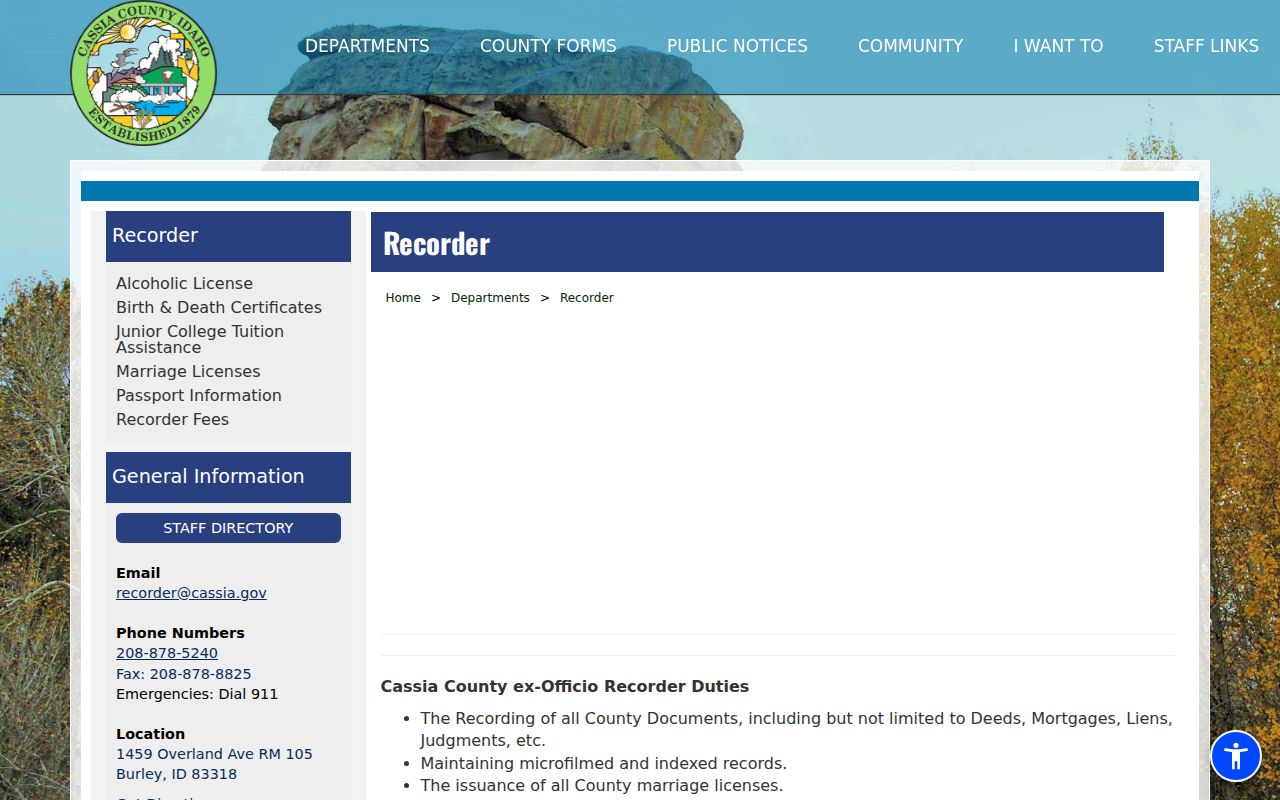
The official page supports an office and microfilm workflow. It establishes no public online grantor-grantee search and no coverage cutoff for deed records.
Resolve Estate Transfers in a Cassia County Ownership Chain
A sequence may seem to stop at a death. In truth, Cassia County property can pass through probate in several forms. A personal-representative deed, executor deed, administrator's deed, court-approved sale, survivorship instrument, transfer-on-death instrument, affidavit, or trust may carry title. The recorded instrument supplies the title event. The District Court probate file explains the representative's authority and the court's order. Search Idaho iCourt by the decedent, estate, or personal representative. Then request the relevant petition, order, inventory, or sale approval through the clerk. Match its parcel description to the Recorder filing. A death certificate proves the event for an eligible requester. It does not transfer title by itself. If no probate appears, check whether survivorship, a trust, or another nonprobate instrument explains the jump.
Extend Cassia County Previous-Owner Research Beyond the Recorder Screen
The Idaho State Archives runs searchable indexes covering Cassia land, tax, court, probate, wills, mining, water-right, and vital records. The index is a finding aid. It does not hold the whole file. Only a fraction of the holdings is digitized. Save both the exact index wording and the full catalog reference. Then request the box, reel, or record group. Appointments need 48 hours' notice. Access runs Wednesday through Saturday. Local newspapers can bridge a stubborn gap before the deed evidence is checked. The Archives finding aid lists Burley Bulletin runs beginning in 1906, Burley Herald from 1919, Cassia County Courier from 1920, and selected Albion Times issues from 1889 and 1892. Probate, tax-sale, subdivision, road, and annexation notices may supply a former-owner name or a place clue, but the recorded instrument remains the proof.
Note: Historic newspaper names are leads; verify each person, date, and land description against the Recorder or court file.
Check the County Behind a Burley Former-Owner Trail
Burley property sits in two counties. The city spans Cassia and Minidoka. So a Burley mailing address proves nothing about where a deed was recorded. Before you build a former-owner timeline, confirm the parcel itself. Check its county roll, tax code, legal description, and instrument county. That step matters most when old subdivision or annexation papers name the city. They may not name the recording jurisdiction.
The trap is real. Burley's Cinema Subdivision, for example, carries a Minidoka County recording reference. The city is Cassia County's seat. So if a deed-chain search goes quiet, repeat the parcel-identity check. Do not assume a Cassia deed is missing. The broader Cassia County deed records guide explains the instrument and copy route in more depth.
Use Cassia County's Courthouse Timeline Without Inventing a Gap
A few courthouse dates frame any Cassia County search. The county was established in 1879. Its seat moved from Albion to Burley in 1918. The present courthouse was built in 1939. Dates like these help you guess where records activity and newspaper references may cluster. They never prove an ownership change for any parcel.
Cassia County reports no courthouse fire, flood, or record loss. Do not invent one to explain a missing link in a deed chain. Instead, ask the Recorder about the earliest index, original books, microfilm, and any reindexed volumes. If the county trail stays incomplete, turn to the Archives catalog next.
How Far Back Cassia County Former-Owner Records Reach
No verified first deed-book year, first grantor-grantee index year, or online imaging cutoff exists in the official material for Cassia County property records. The county does confirm its records are indexed and microfilmed. The honest answer therefore depends on the exact series the Recorder holds. It also depends on what the archival catalog lists. Ask for the earliest book and reel matching the parcel's legal description. Do not quote an unsupported date.
Former-owner work can still reach Cassia County's early years through layered sources. Settlement history, census entries, tax rolls, and newspapers add rich context. They stay context until tied to a deed, patent, probate order, or recorded plat. Federal census material follows the 72-year release rule and anchors a household, not a title. Keep that line clear, and a historical narrative stays separate from a defensible deed chain.
Use records with care. Research prior owners for house history, genealogy, title review, or property diligence, and never use personal details to target or harass anyone.